Why the Databricks IPO Delay Signals AI Infrastructure Has Arrived

Ian WhitestoneMonday, July 27, 2026
TL;DR
Databricks isn't stalling its IPO because the company can't handle public markets. It's staying private because private markets are paying it more to wait. The company is reportedly raising fresh capital at a $165 billion to $175 billion valuation, up from $134 billion six months earlier, on top of a revenue run rate that's accelerating, not slowing, at multibillion-dollar scale. CEO Ali Ghodsi called 2026 a bad year to list, and the numbers back him up. That pattern is a stronger signal for enterprise AI infrastructure than an actual IPO would be.
Search “Databricks IPO” and you'll find the same story repeated every few months: a new valuation, a new rumor, and no filing. It's easy to read that as evasion. It isn't. Databricks keeps getting a better deal to stay private, and the reasons it can command that deal are the real story here, not the date on a calendar.
When is the Databricks IPO date?
There's still no confirmed Databricks IPO date. In June 2026, Databricks CEO Ali Ghodsi told Bloomberg Television that 2026 is a poor year to go public, pointing to a packed IPO calendar that included SpaceX’s June 2026 IPO, as well as potential IPOs from AI giants Anthropic and OpenAI. Reports now point to late 2026 or 2027 at the earliest
The company has explicitly signaled its IPO readiness. Ghodsi said as much back in February 2025, citing the audited financials, board structure, and reporting systems a public listing requires. Readiness and incentive are different things. Every quarter Databricks stays private, it raises another round at a meaningfully higher valuation, without the disclosure requirements, earnings calls, or stock volatility that come with a public ticker. Until that trade stops paying off, don't expect a firm date.
What's the latest Databricks IPO news?
As of June 2026, Databricks is in talks for a new private funding round at a $165 billion to $175 billion valuation, first reported by The Information. That's a 23 to 31 percent jump from the $134 billion valuation set just six months earlier in its December 2025 Series L. The round follows a February 2026 disclosure that Databricks crossed $5.4 billion in annualized revenue, growing more than 65 percent year over year. Independent research firm Sacra estimates that run rate had climbed to roughly $6.9 billion by June 2026, with growth accelerating to around 80 percent year over year in the second quarter.
That acceleration lines up with the broader market. IDC raised its 2026 forecast for AI infrastructure spending to $497 billion this quarter, and Databricks operates squarely inside that category. Software companies almost always slow down once they clear a few billion dollars in revenue. Databricks is speeding up at a size where the opposite is supposed to happen.
If your team is already running Databricks, none of this changes what it costs you today. SELECT gives you DBU and cloud infrastructure spend in one place, broken down to the job and query level. See how it works.
Is Databricks a public company right now?
No. Databricks is privately held. There's no ticker symbol, no public share price, and no way to buy Databricks stock on a regulated exchange today. Prices you see quoted online come from pre-IPO secondary marketplaces such as Forge or Hiive, where accredited investors trade private shares among themselves. Those quotes are directional at best. They reflect thin trading among a small group of buyers and sellers, not a public market clearing price.
What will the Databricks IPO stock price be?
Nobody can answer that with any precision yet, Databricks included. There's no S-1, no share count, and no underwriter attached to a deal. What we do have is a valuation range: $134 billion confirmed in the December 2025 Series L, with reported private-round talks pushing toward $165 billion to $175 billion by mid-2026. Secondary platforms have listed implied share prices anywhere from around $143 to over $250 depending on the platform and the month, which says more about how illiquid that market is than where Databricks will eventually price its shares.
If you're evaluating pre-IPO Databricks stock through one of these platforms, treat the quoted price as a snapshot of current demand, not a forecast. Underwriters will set the actual IPO price against public market comparables at the time of filing, and given how much the private valuation has already moved, that comparable set could look different by then.
Why is the Databricks IPO delay actually bullish for AI infrastructure?
Here's the case worth making directly: Databricks staying private longer is a stronger signal for AI data infrastructure than an IPO would be.
Consider what “ready but not going” requires. It requires growth speeding up, not slowing down, at multibillion-dollar scale. Databricks went from 55 percent year-over-year growth in December 2025 to 65 percent in February 2026 to an estimated 80 percent by June 2026. It requires net dollar retention holding above 140 percent, ahead of every comparable public software company. And it requires private investors willing to pay a valuation more than double the largest public company in the same category, betting the growth compounds instead of resetting.
Gartner expects AI infrastructure to account for more than 45 percent of the $2.59 trillion in worldwide AI spending this year, and Databricks is one direct way enterprises spend into that category. Databricks runs its lakehouse platform across AWS, Azure, and Google Cloud, which makes it infrastructure, not a single-cloud tool. Snowflake and BigQuery compete in the same data platform space, and Snowflake, the closest public comparison, shows the gap plainly:
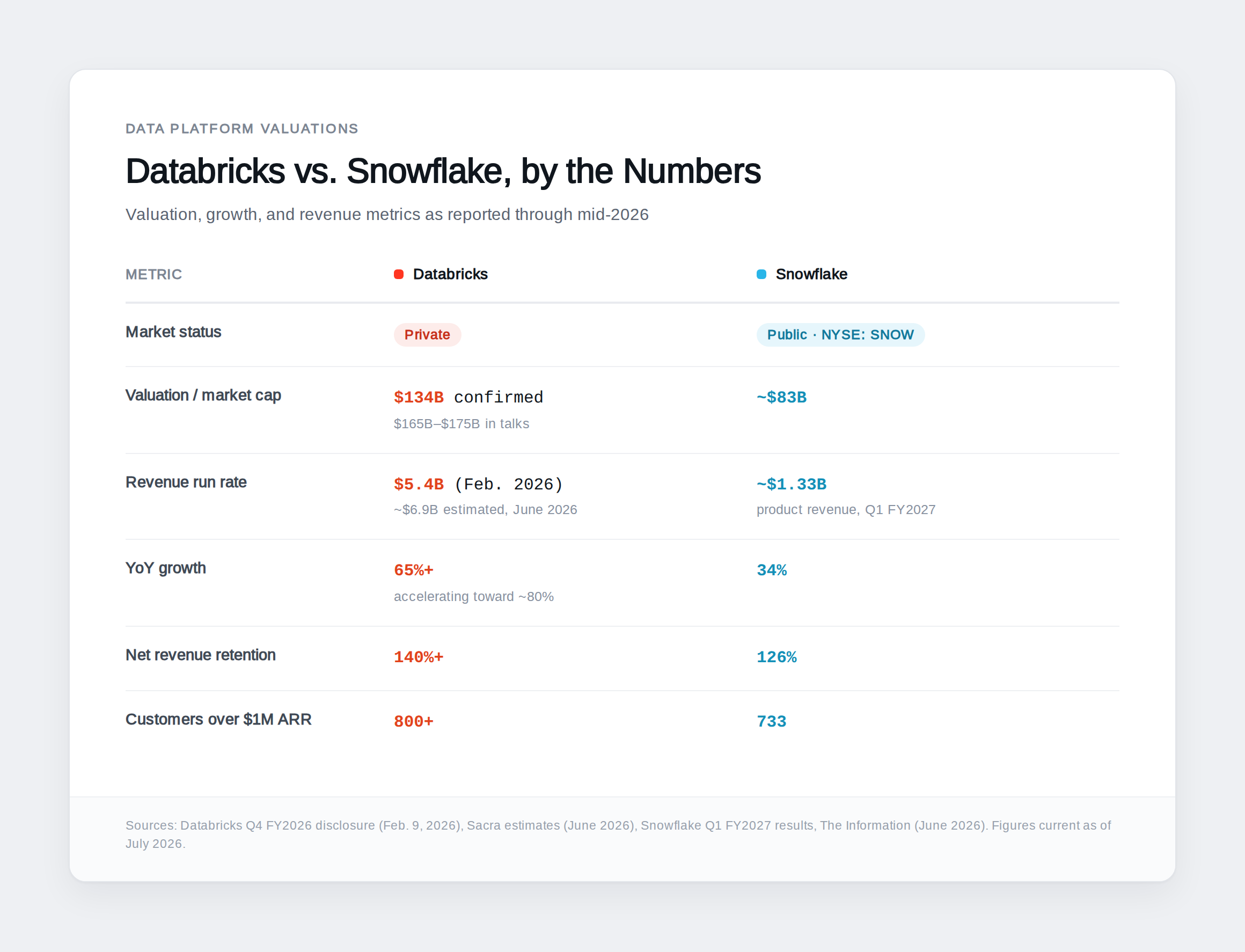
Sources: Databricks Q4 FY2026 disclosure (Feb. 9, 2026), Sacra estimates (June 2026), Snowflake Q1 FY2027 results, The Information (June 2026). Figures current as of July 2026.
Databricks' AI products alone crossed a $1.4 billion revenue run rate, up from about $1 billion the quarter before. On their own, they'd rank among the top 20 public software businesses by revenue. That's not a company benefiting from AI demand. That's a company most enterprise AI initiatives now depend on to govern and serve their data in the first place.
The skeptical case deserves a fair hearing too. Consumption-based pricing means revenue and margins can move with usage in ways subscription software doesn't, and rising AI compute costs are already pressuring gross margins that once ran near 80 percent. One quarter of decelerating growth would reprice the entire IPO story fast. That's a real risk worth watching. It's a reason to track the growth rate closely, not a reason to bet against the category Databricks has helped define.
What should enterprises running Databricks do now?
Whichever side of that debate you land on, the operational reality doesn't wait for an S-1. Databricks' pricing model gets more complex as the platform expands into Lakebase, Genie, and Agent Bricks. More products, more usage-based billing lines, and more AI-driven compute mean more places for spend to grow faster than teams expect.
That shift is already showing up at the practitioner level. The FinOps Foundation's 2026 survey found that 98 percent of teams now manage AI spend directly, up from just 31 percent two years earlier, so this isn't a hypothetical problem for most FinOps practices anymore. Treat it as an operating problem to plan for, not a budget to police after the fact.
Our own Ian Whitestone and Databricks consultant Olivier Soucy recently mapped out five concrete ways to cut Databricks waste without slowing teams down, from auto-termination defaults to workflow redesign, worth a read if you want tactics beyond what's here. Getting clear visibility into what's actually driving Databricks consumption, and building that into your FinOps practice now, gives engineering and finance teams a shared view of cost before a surprise bill forces the conversation. That's the same discipline DoiT applies across AWS, Azure, Google Cloud, and the data platforms running on top of them.
Want the full five-step framework? The Guide to Databricks Cost Optimization, written by a Principal Data Engineer who's built production Databricks environments, walks through where to start, when to go serverless, and the timeout configs most teams skip. Download the free guide.
Frequently asked questions
Is Databricks going public in 2026?
No firm date has been set. Databricks CEO Ali Ghodsi told Bloomberg in June 2026 that 2026 is a poor year to list, given a crowded IPO calendar. Reports point to late 2026 or 2027 at the earliest, and even that window is unconfirmed.
What is Databricks worth right now?
Databricks was valued at $134 billion in its December 2025 Series L round. As of June 2026, the company is reportedly in talks for a new private Series M round at $165 billion to $175 billion, according to The Information.
Can I buy Databricks stock before the IPO?
Not on a public exchange. Accredited investors can buy pre-IPO shares through secondary marketplaces like Forge or Hiive, but those prices reflect thin, illiquid trading, not a real public market price.
Is Databricks profitable?
Databricks reported positive free cash flow over the trailing 12 months as of its February 2026 disclosure. It hasn't published GAAP net income figures, which companies typically withhold until an S-1 filing.
Will Databricks IPO on the Nasdaq or NYSE?
Databricks hasn't confirmed an exchange. Most coverage assumes a Nasdaq listing, consistent with recent large-cap enterprise software IPOs, but the company hasn't announced one.
Valuation, revenue, and growth figures reflect the most recent disclosures and reporting available as of July 2026 and are subject to change as Databricks releases new figures or moves toward a filing.
Ian is the Co-founder & CEO of SELECT, a SaaS Snowflake cost management and optimization platform. Prior to starting SELECT, Ian spent 6 years leading full stack data science & engineering teams at Shopify and Capital One. At Shopify, Ian led the efforts to optimize their data warehouse and increase cost observability.
Want to hear about our latest data cloud learnings?Subscribe to get notified.
Get up and running in less than 15 minutes
Connect your Snowflake, Databricks, or BigQuery account and instantly understand your savings potential.