Databricks Genie Pricing: What It Actually Costs to Run

Olivier SoucyThursday, August 27, 2026
TL;DR
Genie bills in two separate streams: LLM usage and the compute it triggers. Every identified user gets 150 free DBUs a month for Genie Code. Genie One and Genie Agents stay free for user interactions through January 31, 2027. None of that covers the SQL warehouse or serverless compute Genie starts to actually answer you. We ran a real test to see what that adds up to, and the number that came back first wasn't the number that mattered.
"Genie is free" is only half true, and it's the easy half. The AI usage behind Genie has a generous free allowance and a clear meter. The compute Genie triggers to actually answer your question doesn't share either of those traits. Here's how the billing actually works, what a real Genie session cost us when we tracked it, and where the number gets harder to trust than it looks.
Why does Genie have two separate bills?
Genie's job splits into two different kinds of work, and Databricks bills them differently. The first is understanding your request: reading the question, planning a response, writing SQL or code. That's LLM usage, measured in Databricks Units (DBUs). The second is running whatever it just wrote: a query against a SQL warehouse, a Python job on serverless compute. That's ordinary Databricks compute, billed the same way it always has been.
Most teams budget for the first one and get surprised by the second. IDC warns that G1000 organizations face up to a 30% rise in underestimated AI infrastructure costs by 2027, driven less by overspending than by opaque consumption models that standard budgeting never accounted for. Genie is a clean example of exactly that pattern: one visible meter, one invisible one, both real.
How much of Genie is free right now?
Genie Code gives every identified user 150 free DBUs of LLM usage each month. The allowance resets monthly, and it works out to roughly $10 to $11 of usage at typical rates, though the exact dollar figure depends on your cloud provider and region. Genie One and Genie Agents run on a different mechanism entirely: user interactions with both stay free through January 31, 2027, as a time-limited promotion rather than a recurring allowance.
Service principals get neither deal. Any Genie usage tied to a service principal bills from the first request, no free allowance at all. That's worth remembering if you're calling Genie programmatically rather than clicking through it, since automated usage scales in a way a person clicking through a chat interface doesn't.
What happens once you use up the free allowance?
Genie Code usage beyond the 150 free DBUs moves to pay-as-you-go billing, priced the same way the rest of Databricks' LLM-backed features are: per DBU, based on actual consumption, with no seat fee layered on top. Genie One and Genie Agents don't have a pay-as-you-go tier yet. Right now they're simply free for users until the promotion ends on January 31, 2027, at which point Databricks will presumably fold them into a similar metered model. Rates differ slightly across AWS, Azure, and Google Cloud, so a number that holds on one cloud won't necessarily hold on another.
What does a real Genie session actually cost?
We didn't stop at reading the pricing page. Building the stock portfolio agent from our last post ran up a real bill, so we pulled the numbers from the billing system tables afterward to see what it actually consumed.
The first pass said $5.12 at list prices: $4.34 in SQL Serverless, $0.77 in All-Purpose Serverless, and $0.00 in Genie LLM usage. The LLM side was the easy part to trust. The exercise used about 102 DBUs of Genie LLM usage, split 79.7 from Genie Code and 22.7 from Genie One and Agents. It came back free because it landed inside the monthly allowance and the promotional window. Had the Genie Code portion fallen outside the free allowance, that piece alone would have run about $4.18.
Why didn't that number tell us the whole story?
The $5.12 compute figure turned out to be misleading. It counted every query that warehouse ran during the test window, whether Genie triggered it or not. Databricks' billing system tables tag Genie's LLM usage explicitly: a record with billing_origin_product = 'GENIE' tells you exactly what generated it. Genie's compute doesn't get that same tag. A SQL warehouse bill just says a warehouse ran; it doesn't say whether a person or a Genie Agent asked for it.
Forrester expects enterprises to defer 25% of planned AI spending into 2027 as tighter financial scrutiny replaces looser pilot-stage budgets, and untraceable numbers like this one are exactly what invites that scrutiny. A finance team that can't tell which line items came from Genie has no way to defend the ones that did.
How do you check what Genie is actually costing you today?
For the LLM side, query system.billing.usage filtered to billing_origin_product = 'GENIE', joined against system.billing.list_prices for the rate. That gives you a clean read on DBUs by surface (Genie One, Agents, or Code) and by agent, including the free and promotional usage, which shows up with no price attached rather than disappearing from the data.
Unity AI Gateway budgets sit on top of that same LLM meter, scoped to an account, workspace, user group, or individual users, tagged databricks-product: genie. That tag is additive, so layering on more tags doesn't break tracking. It just makes your reporting more granular. A platform like SELECT for Databricks can help here too, since it already reconciles Databricks DBU spend against the underlying cloud infrastructure cost Databricks doesn't break out on its own, which is the same problem Genie's compute side runs into.
FinOps Foundation leadership has started framing tokens as their own unit of technology spend, distinct from the compute they run on, and Genie's billing model is a small-scale version of exactly that split. Treating the two halves as one number is how teams lose track of which half is actually growing.
None of this covers the compute side, though. Unity AI Gateway budgets stop at LLM usage. Getting a clean read on the SQL warehouse and serverless costs Genie triggers takes a different approach, dedicated compute, consistent tagging, and a bit of architectural discipline, which we'll cover in the next part of this series.
What's the quick version?
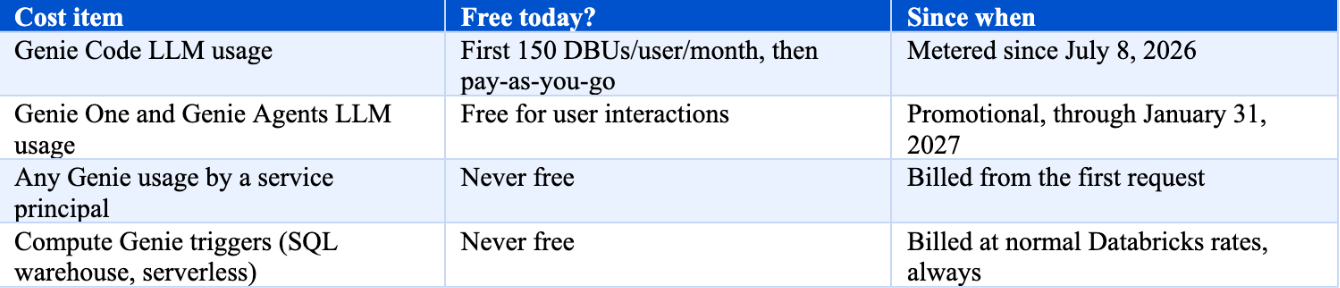
Databricks Genie pricing summary, current as of August 2026. Check the Databricks pricing page before budgeting against these numbers, since the model has already changed more than once this year.
"Free Genie" was never the same thing as a free Genie session. Ours cost real money the moment it ran a query, and the part that should have been the hard number to pin down, the AI usage, was actually the easy one. The part everyone assumes is just normal Databricks usage is where the real cost lives, and where it's hardest to see. That gap is exactly what we dig into next: how to make Genie's compute attributable before the bill arrives, not after. Get the full walkthrough, including the query we used, in our ebook, Databricks Genie Explained.
Frequently asked questions
Is Databricks Genie actually free?
Partly. Genie One and Genie Agents stay free for user interactions through January 31, 2027, and Genie Code gives every user 150 free DBUs a month. None of that covers the SQL warehouse or serverless compute Genie triggers to run its answers, which bills at normal Databricks rates regardless of the free allowance.
How many free DBUs does Genie Code include?
Every identified user gets 150 free DBUs of Genie Code LLM usage each month, resetting monthly. Usage beyond that bills pay-as-you-go. Service principals don't get this allowance at all.
Why is Genie's compute cost hard to track?
Because Databricks tags Genie's LLM usage explicitly in the billing system tables, but not the compute it triggers. A SQL warehouse query started by a Genie Agent looks identical, in billing data, to one started by a person typing SQL directly.
Does a Genie budget cover compute costs?
No. Unity AI Gateway budgets, tagged databricks-product: genie, control LLM usage only. They don't touch the SQL warehouse or serverless compute Genie triggers, which needs its own cost controls.
What did a real Genie test actually cost?
In our own test, a Genie session used about 102 DBUs of LLM usage, free under the monthly allowance and promotion, alongside $5.12 of compute at list prices, though that compute figure included other queries running on the same warehouse and wasn't cleanly attributable to Genie alone.
Fractional Data Platform Engineer | Open-source Developer | Databricks Partner
Want to hear about our latest data cloud learnings?Subscribe to get notified.
Get up and running in less than 15 minutes
Connect your Snowflake, Databricks, or BigQuery account and instantly understand your savings potential.